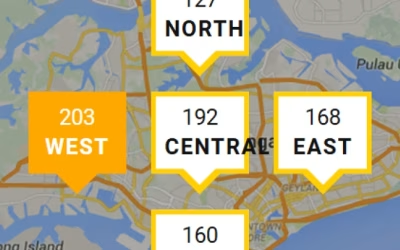
First, on air quality. As part of its air quality monitoring regime, NEA monitors ambient levels of volatile organic compounds, or VOCs, through our network of 24/7 ambient air monitoring stations at various locations in Singapore. One of the monitoring stations is located on Sentosa and there is also one at the eastern-end of East Coast Park. The monitoring stations did not detect any anomalies over this period of time, including for benzene, toluene and xylene, or BTX, that are commonly associated with bunkering fuels and other petrochemicals.
When the oil slick reached stretches of our coastline on 15 June, NEA began conducting daily air quality tests using mobile detectors at affected areas of East Coast Park, Sentosa and Labrador Nature Reserve to ensure the safety of the public and clean-up personnel. The VOCs detected, including for BTX, have been well within safe limits.
Miss Rachel Ong1 asked if there were health and safety concerns from breathing in the oil fumes. I have explained that the air quality at affected areas is safe, based on both measurements from our 24/7 ambient air monitoring stations as well as localised daily testing using mobile detectors. While members of the public near the beachfront or shoreline may experience odour from time to time, especially in the early days of the oil spill, it is safe to be around these areas.
Second, as part of the SOP, service providers are involved in our oil spill response in many critical functions. Many of them are specialised contractors involved in the laying of booms and in cleaning of difficult-to-clean areas, such as rock bunds. Others are general cleaning contractors involved in clearing the beaches of oily sand and debris. These service providers participate in our regular oil spill exercises and are familiar with their roles and processes. Before deployment, personnel are briefed on their tasks and workplace safety.
Agencies and their contractors are regularly reminded to ensure that sufficient rest breaks and rehydration are provided. We have also reminded cleaning contractors to ensure that workers receive rest days and consider rotating workers, where possible. Workers who feel unwell should approach their employer for support and assistance.
Third, on protective equipment. Mr Louis Ng, Ms He Ting Ru, Mr Melvin Yong and Miss Rachel Ong2 asked about the provision of Personal Protective Equipment (PPE) for our workers. As is the case for any work carried out in Singapore, employers, including the contractors, are responsible for assessing the site conditions, nature of tasks and risks when deploying and equipping their workers.
In the immediate few days after the oil spill, when a sizeable amount of oil was washed up on shore, NEA issued a general advisory for personnel involved in the clean-up effort to include masks, goggles, rubber gloves and high waterproof boots as part of their PPE. This was done as an additional precaution even though the air quality was well within safe levels. After the bulk of the oil was removed, NEA updated the advisory to no longer require masks and goggles.
The first phase of the clean-up focused on removing the oil slicks and contaminated sand from the surface of affected beaches and deploying booms to avoid further contamination. All the remaining affected areas have entered the second phase of the clean-up response, which focuses on difficult to clean areas like rock bunds, breakwaters and oil trapped deeper in the sand. Members of the public may notice a scaling down of general cleaning at the beaches, as more specialised teams are deployed to clean these difficult areas. General cleaning of the beaches may still be required, as oil remnants may continue to be washed ashore.
The cleaning methods for the second phase have been decided jointly between the oil spill consultants and the cleaning contractors. These methods may be refined along the way as the shoreline of each affected area may be different. For ecologically-sensitive locations, the National Parks Board (NParks) is consulted on the methods to be deployed.
Once the second phase of cleaning operation is completed, we will move to the final phase where we remove tar balls from the beaches and inspect affected areas for any remaining oil stains.
We expect the clean-up to take around three months, but these will vary for each area, depending on the extent they are affected. ONE°15 Marina and the Marina at Keppel Bay have reopened as clean-up efforts continue to progress. The cordoned-off area of the beaches at Sentosa, along East Coast Park and Southern Islands will progressively open for land-based activities. We will test the water quality to ensure that it is back to normal and stable for at least a week before resuming swimming and other primary-contact sea activities.
Agencies have been monitoring the situation carefully and closely. We understand the frustration and inconvenience that businesses have experienced due to the oil spill. That is why SDC, which manages Sentosa and businesses on the Southern Islands, and other agencies, such as NParks, that collectively manage the beachfront along East Coast Park, have been proactively reaching out to their tenants.
The agencies are developing rental deferral measures to help affected businesses with their cash flow on a case-by-case basis. SDC will also look to promote a return of footfall through marketing and social media support.
As mentioned by the Ministry of Transport (MOT) during last week's joint press conference, the economic losses resulting from the oil spill can be accessed for claims. Contact details of the insurer have been made available to the public.
Many volunteers have stepped forward to offer their assistance in the clean-up operations. Volunteers have not been directly involved in the beach clean-up actions, due to the complexity of the tasks and for their personal safety.
Ms Nadia Ahmad Samdin asked how citizens can be involved in our clean-up efforts. We are considering mobilising volunteers for the final phase of the clean-up, where remnant oil deposits hardened and mixed with sand in the form of tar balls will need to be sieved and separated for removal. This process is labour-intensive and if we have more hands to help, we can relieve the cleaners and accelerate the reopening of the beaches.