Mr Chua Kheng Wee Louis asked the Minister for Education (a) whether the Ministry tracks the number of reported bullying cases in schools; (b) if so, what is the number of bullying cases in each year of the last five years; (c) if not, why not; and (d) what resources and policies are being put in place in schools to enhance the detection, reporting and correction of bullying cases.
Ms Hany Soh asked the Minister for Education (a) whether the Ministry has observed a rising trend in bullying cases involving school students; and (b) how can the Ministry better prevent bullying of school students and support victims of bullying.
Ms He Ting Ru asked the Minister for Education (a) in the last five years, what are the observed trends relating to the number of bullying cases schools have received; (b) what is the breakdown between online and offline bullying incidents reported to schools; and (c) whether there are any special guidelines given or approaches taken for cases of bullying involving students with neurodiverse conditions or disabilities and, if so, what are they.
The Minister for Education (Mr Chan Chun Sing): Mr Speaker, may I have your permission to take Question Nos 20 to 28, please.
Mr Speaker: Yes, you may.
Mr Chan Chun Sing: Mr Speaker, Sir, my response will address the questions raised by Members Mr Zhulkarnain Abdul Rahim, Dr Wan Rizal, Mr Christopher de Souza, Mr Liang Eng Hwa, Mr Gerald Giam Yean Song, Mr Yip Hon Weng, Mr Chua Kheng Wee Louis, Ms Hany Soh and Ms He Ting Ru on the bullying incidents in schools and Institutes of Higher Learning (IHLs), that recently caught public attention on the Internet.
My response will also cover related questions from Ms Hazel Poa, Mr Sharael Taha, Mr Gan Thiam Poh and Assoc Prof Jamus Lim, which are scheduled for subsequent Sittings.
Mr Speaker: Alright. Minister, I think you mentioned Question No 28. But it stops at Question No 27.
Mr Chan Chun Sing: Sir, my apologies, till Question No 27.
The Ministry of Education (MOE) takes a serious view of all forms of hurtful behaviour, from once-off insensitive remarks to more persistent, intentional acts of bullying and even physical violence. Schools and IHLs have rules and regulations which prohibit any form of bullying. Our schools and IHLs educate students against these negative behaviours and work with families, the community and partners to intervene promptly and address them.
Members Ms Hany Soh, Mr Gerald Giam, Mr Louis Chua asked about the trends in bullying incidents. In the last five years, the average number of bullying incidents has remained steady. For every 1,000 students, there were an average of two incidents in primary schools and six incidents in secondary schools annually for any form of bullying, both within and outside of school. Of these, incidents involving the use of technology averaged less than one incident per 1,000 secondary students and even fewer in primary schools each year.
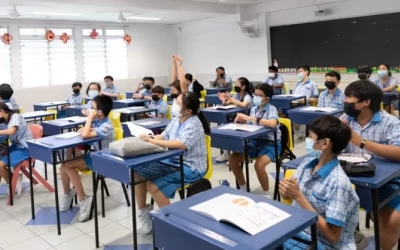
Members Mr Zhulkarnain Abdul Rahim and Dr Wan Rizal asked about how MOE educates our students and equips them to deal with threats of bullying. From young, students learn pro-social behaviours through lessons and role-modelling. Through the Character and Citizenship Education (CCE) curriculum and a school environment that emphasises values and respect, students acquire skills to be kind to their classmates, resolve disagreements respectfully and stand up against bullying.
Students learn what to do when they encounter unsafe situations. Stay calm, do not retaliate, but move away and seek help from adults nearby, and alert their teachers and parents. These lessons extend to the cyberspace. Through cyber wellness lessons, students learn to be respectful and responsible users online. Whether online or offline, they should report any incident of bullying to their teachers or School Leaders.
As students sometimes prefer to turn to their friends for support, schools have established peer support networks and trained students to help and look out for one another, and in conflict management.
These educative efforts continue in our IHLs, which raise awareness about anti-bullying through modules teaching respect and appropriate behaviour, as well as peer support structures.
Members Mr Yip Hon Weng, Ms Hazel Poa, Mr Christopher de Souza and others asked about the intervention and support for bullying victims and perpetrators, and how schools collaborate with families, community partners and Police to address them. Teachers are trained to create a positive classroom culture, recognise distressed students, and proactively address hurtful behaviours and bullying. All pre-service teachers receive this training, and new teachers are supported by experienced staff and school counsellors. In-service teachers also receive refresher training as part of their professional development.
When any incident of bullying within or outside schools is reported, schools and IHLs conduct thorough investigations before deciding on the appropriate course of action. We adopt a tiered approach based on the severity of incident. In cases arising from careless remarks and misunderstandings, teachers guide students to resolve their differences and reach a common understanding. For cases involving persistent, intentional acts of bullying, serious disciplinary actions are taken in addition to the restorative actions. For cyber bullying incidents, schools guide students to report these to the online service provider. When schools and IHLs come to know of any incident of severe bullying or fights, they work closely with parents and the authorities to ensure students' well-being and safety. They also mete out the necessary disciplinary consequences and guide students to change their thinking and behaviours so that they can learn to be responsible members of the community.
Similarly, our schools and IHLs consider the seriousness of the incident and take into consideration the profile and needs of the students involved, when taking disciplinary actions. Schools may put perpetrators on detention or even suspend them from attending lessons. Caning is used as a last resort for boys and carried out in an appropriate manner only by authorised adults. For severe bullying or fights, a Police report will be made and perpetrators will face legal consequences in accordance with the law.