And it does not stop with such tariff items. It goes beyond tariffs. For example, China has restricted rare earth exports. What are rare earths? They are raw materials which you need to make all kinds of electronics equipment, and China is a major exporter. If you do not get it from China, it is very difficult to get it from other places. So China says, 「You do this to me, I will respond. I will restrict rare earth exports. And if you do not want me to sell you goods, okay. I will not buy your goods is one thing, but I will also restrict imports of Hollywood films.」 Films are not goods, because films you just stream over, it is services. But never mind, I will restrict that. I will not watch Disney, I will watch Ne Zha 2.
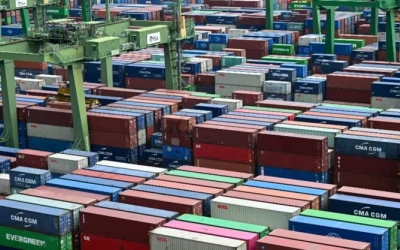
So effectively, the bilateral trade is going to get killed. And why? Because the businesses just cannot do it. If the tariff is five percent, 10%, maybe even 15%, okay I am selling it to you, let’s cham siong. You take 5%, I take 10%, we squeeze our belts a little bit – my profit a bit less, your cost a bit higher, okay, let us try to stay calm and carry on. But when it is 150%, 200%, and you do not know what is going to happen tomorrow or day after, then you cannot stay calm and carry on. You must stay calm, and then you may have to decide to go into a different business or to go out of business. And that means entire businesses and trade flows are going to stop.
And it would not end with trade, because if I am quarrelling with you on such a serious matter, it is very difficult for me to cooperate with you on other equally serious things. So, for example, the Americans want China to cooperate on restricting fentanyl, because the materials to make fentanyl come from China; somehow they go to Mexico and other places, they are made into fentanyl, then smuggled into the US. And America wants China to stop making the precursor chemicals. But China says, well, why should I try very hard? So this is going to escalate, and there will be far reaching consequences for US-China relations.
This is not a new problem, actually. It is not a problem which started with this President. It is a problem which has been growing for quite a number of years. The attitudes changed when Obama became President. Over time, they hardened. So it is Democrats as well as Republicans. We say that the Americans are divided. But on China, the Americans are united. They have a strong consensus that China is a pacing challenge, and they have to take China very seriously and actively. They are trying very hard to stay ahead of China and to prevent China from overtaking them. At the same time, the Chinese say, "I am growing, I am developing. I want to take my rightful place in the world. Who is going to stop me?" So, this is a fundamental contradiction. The Americans say, "I want to make sure that you do not overtake me". The Chinese say, "I have a right to develop". We can talk about win-win, but when you cast it like that, there is a fundamental contradiction, and it is not going to be easily resolved. The latest trade war has worsened it. And it is going to be a serious problem for the two countries and also for the world.
So what do we do about it? Some people say, "Do not get excited, do not overblow the issue. We have weathered bigger storms before. We have not failed. We should take these events in our own stride." And it is true, we should not get excited. We should take it in our own stride. But we do need to be concerned and to understand what is happening and what this means for us. Because this time, something important is different.
We have gone through many crises before over the years. We have gone through the Global Financial Crisis, before that, Asian financial crisis. We had SARS. Most recently, we have had COVID-19. And every now and again something happens in the world, we have carried along, and we have to batten down our hatches and see it through. And every time we have succeeded, so we have confidence. But one important thing which you must understand is that every time that happened, we had two big things going in our favour. One, within Singapore, we were doing the right thing. We could get united. We could get our act together. We could respond with the right policies, even painful ones. And we could get the system, get ourselves sorted out. Two, every time we got into trouble last time, Singapore was part of a working global economic system, trading system. And that trading system promoted free flow of trade, free flow of investments; it encouraged MNCs to look for places to do business. We were efficient. We were doing well. We came out from trouble, we plugged back in. We could resume growing, resume developing, resume succeeding. So every time you run into trouble, you come up, you plug it, you grow it. Next time there is trouble, you come out, the system is still there.
It is a global financial system, the WTO system. And that was what helped us. What was it about that system which helped us? It gave countries big and small a level playing field. Whether you are a big country or a small country, under the WTO system, the rules are the same, your access is the same. What do I mean? Let's say between countries. We trade, right? Sometimes we have tariffs, sometimes we have other restrictions. You are allowed to do that, but you may not discriminate between your partners, big ones and small ones. Let us take an example, if the EU raises tariffs on cars from Japan. In order to protect European cars, you raise tariffs on Nissan or Toyota, then you must charge the same tariff on cars from every other country; Chinese cars, Korean cars, Indian cars, American cars. You have to treat them the same. If Singapore had cars to export, Singapore would also be charged the same tariffs.
On the other hand, if we give a concession to a country – for example, if Australia says, 「I allow rice from India to be sold duty-free」, then they have to do the same for rice from all other countries: Japanese rice, Chinese rice, Vietnamese rice, and American rice. Everybody has to come in also duty-free. It has to be a level playing field. You can protect yourself, but you cannot discriminate between your partners. And that is called MFN - Most Favoured Nation. It sounds like if you are MFN, that you get some special favour – 「most favoured」 – but actually most favoured just means equal favour, means you do not get more than anybody else, and you do not get less than anybody else. And it is a level playing field for countries big and small. But what it means is that for small countries, who have very little bargaining power, because the rules are like that, so we enjoy the same market access which big countries enjoy, and we benefit from the bargaining power of bigger countries. And therefore, we can get access, and therefore we can get investments, and therefore we can get jobs. So, MFN is critical to Singapore.
What is different this time is that the US does not want MFN. They want to dismantle the system. They want to replace MFN with reciprocal tariffs, meaning I would not treat everybody equally. I want to treat each person, each partner, one-on-one. I deal with you, you deal with me. What you give me, I give you, at least in principle. When you bargain, of course, I would like you to give me a little bit more, and therefore, exploit America's bargaining power. Because they are big – one quarter of the world’s GDP, one seventh of total goods trade in the world. 「Why treat everybody equally? They do not have the cards.」 To borrow some famous words. Why not we treat this one-on-one, like arm wrestling. Let's see who has got more biceps, who has got a stronger arm, and we will see who is stronger. We will get more that way. It is a fundamentally different kind of world which the US is looking for and pushing for. And the approach is not win-win, but win-lose. In other words, the US wants to do well for themselves. They really do not mind whether the other countries do well for themselves. And President Trump recently is on record saying, 「If we had made a really fair deal and a good deal for the United States, not a good deal for the others, this is America first. It is now America first.」
So this has very major implications for Singapore, very major implications for the world.
Why this is bad for the world
What does it mean for the world?
First, you are going to have different rules for different countries. Small countries will suffer because they have no bargaining power. But even big countries will not do well because there is going to be a lot of confusion, a lot of uncertainties, a lot of differences in the rules. And far fewer opportunities to trade, to invest, to do business together.