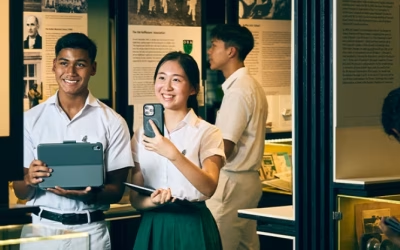
The polytechnics will continue to equip students with the necessary and in-demand skills and competencies by working closely with industry partners to ensure that our curriculum remain relevant and responsive to the evolving job market demands, as well as to provide quality internship opportunities for students. The polytechnics further support students by providing Education and Career Guidance as part of the curriculum, which includes resume writing and interview skills training. Those who require more support in finding a job can also tap on the career matching services and digital resources offered by Workforce Singapore’s and the National Trades Union Congress』 (NTUC’s) Employment and Employability Institute.
For 2025, given global economic uncertainties, we will continue to monitor the situation closely together with the polytechnics and industry partners.
Mr Speaker: Mr Pritam Singh.
Mr Pritam Singh (Aljunied): Thank you, Mr Speaker. Just to clarify with the Minister, I think that in his preamble to the reply, he mentioned that I had an additional question in future Sittings or so. I do not have any questions for future Sitting. This is the only one.
Mr Chan Chun Sing: Yes.
Mr Pritam Singh: I have two questions, Mr Speaker. One, according to the Polytechnic Graduate Employment Survey 2024, the unemployment rate for fresh undergraduates rose from 7.3% in 2023, to 12.5% in 2024, comparable to the numbers at the height of the COVID-19 pandemic. Is the Minister concerned about the prospect of under-employment amongst polytechnic graduates, and would he direct the polytechnics to track under-employment data in future iterations of the Graduate Employment Survey?
I understand that the Ministry of Education (MOE) is concerned about under-employment, when it determines how many places are open in universities for different students, for example, for computer science. And I am wondering whether there is a similar concern at the polytechnics and the number of students who apply for polytechnic courses. The Minister mentioned in his reply that the numbers seem higher for engineering, and information and digital technologies-related courses, and hence, the concern would also apply with regard to under-employment here.
The second question I have is that almost 10 years have passed since this House debated MOE’s Applied Study in Polytechnics and ITE Review (ASPIRE) report, which sought to strengthen applied education at polytechnics and the Institute of Technical Education (ITE). What is the Ministry’s assessment of the progress made in the ASPIRE report’s recommendations in equipping polytechnic graduates with: one, strong skills foundation; and two, sector linkages with industry to help enhance programme offerings, so as to ensure good job outcomes for our polytechnic graduates?
Mr Chan Chun Sing: Mr Speaker, Sir, if I may answer the Member’s questions together and put in context some of the data that has been discussed.
Over time, we have seen the following trends. The first is that the number of polytechnic graduate students that are continuing further studies has increased. So, the base of the people that are going into full-time employment directly has decreased. So, this is an important point.
Within the group of people who are going into full-time employment – this is what we are talking about in this particular survey – the long-term secular trend, more polytechnic graduates go on to study immediately before they enter the job market. That is, in some sense, a positive trend. Then, those who go directly into work are the remainder 45% or so, and within this 45%, that is where we get the uptick of last year, about a 5% of this 45%, in change in the unemployment. So, that is the first point.
The second point to Mr Singh’s question about measuring under-employment. This is not something that is easy to do because the definition of under-employment varies across different sectors and perceptions, from the International Labour Organization (ILO) to NTUC and even the Ministry of Manpower, they have different ways of trying to measure it. It also depends on who you ask. If you ask the students whether they are under-employed, I think the answer is quite different than if you ask the boss whether they think their employee is under-employed, especially for fresh graduates. So, I think there is some limitation in what we can do.
Having said that, the larger issue that we have to appreciate is how do we make sure that our polytechnic graduates, or for that matter, ITE graduates, and even our university graduates, can get fulfilling jobs that earn them a good salary, not just at the entry point, but also throughout their career? We have to do this on a few fronts – and this is also in response to the progress that we have made on the ASPIRE report.
The first thing that we need to do, is that we need very close industry-and-polytechnic, industry-and-ITE, and industry-and-university collaborations. Because it takes us two to three years to produce a graduate and we must be able to work with the industry to forecast demand, not just in terms of numbers, but the type of skills required in a few years』 time. This is by no means an easy job, because even the industry will know that in two to three years』 time, the type of skillsets that are required and are most marketable may change and may evolve over time. But the first thing is for us to make sure that we work closely with the industries, the Ministry of Trade and Industry, to forecast the demand.
The second thing is that in a fast-evolving world, I think nobody will be able to say, 「My course will fit nicely into a particular job in two to three years』 time」. What we need to equip our people with are not just the skillsets of a particular job, but also adjacent competencies that allow them to pivot into what we call adjacent jobs or complementary jobs that will make them much more employable. Some of these are hard skills, some of these are soft skills. Some of these are skills that allow them to work with other partners across different nationalities so that we can widen the market opportunities for them, so that they can pivot, not necessarily just at the beginning, but also throughout their career.
So, this is how we must continue to work to make sure that our courses are relevant with industry input and at the same time, equip our people with the skills that are complementary, fungible, that they can have wider options, rather than be narrowly type-cast or siloed into specific sectors. And that is what the ASPIRE report has tried to do and will continue to progress on these fronts.
Mr Speaker: Mr Singh.
Mr Pritam Singh: Thank you, Mr Speaker. I note Minister’s points about the transit of polytechnic graduates into degree courses and understandably so. I think in the previous decade, MOE had also envisage the cohort participation rate for students entering universities to be on the increase and it is 42% now compared to previously. And of course, the other factor is we have got applied learning universities now as well and that may in itself be a positive fillip with regard to the ASPIRE report.