As Dawn mentioned earlier, these awards were first launched in 2015, during SG50, in support of the Government’s Partnerships for Capability Transformation, or PACT, programme.
I commend SICC for promoting innovation, particularly collaborative innovation, over this past decade.
Starting out with two categories, you now have expanded to five, reflecting the evolving and dynamic nature of innovation.
SICC’s commitment to bringing businesses together, and connecting local and foreign enterprises, has been longstanding.
SICC has just turned 188 – what a role model for active ageing and healthy longevity!
The Chamber was founded in the 1830s to advocate for Singapore to remain a free port, facilitating trade flows between East and West and supporting the development of an open, inter-connected global economy.
This was around the peak of the first Industrial Revolution, when a proliferation of new technologies led to a surge in manufacturing output, particularly in Western economies.
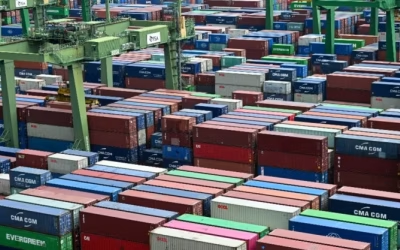
The economist Adam Smith’s insight on the division of labour, specialisation and free markets laid the foundations for what we know today as modern industry, supply chains and globalised trade.
The division of labour, leveraging on economic complementarities and global competitive forces that drive efficiency and innovation, has spurred higher growth in trade and economic growth, especially in developing economies.
For example, between 1970 and 2023, the exports of goods and services worldwide grew from 12.8% to 29.3% of global GDP.
In that same time period, global GDP per capita rose about 16 times from roughly US$816 to more than US$13,000.
In low and middle-income countries, the improvement was even more impressive.
GDP per capita grew almost 29 times – from US$196 in 1970 to more than US$5,600 in 2023.
Now, the brief facts and figures that I have just outlined show that the global division of labour has been a key driver of progress for all countries.
I was in Doha back in 2001 for the launch of the WTO’s Doha Round of trade negotiations.
Unfortunately, in these 24 years, the Doha Round has made no progress.
Instead, we are regressing – with trade wars growing in intensity, even among countries with Free Trade Agreements.
Tariffs are being weaponised to pursue non-economic objectives, and trade and other economic agreements are being upended abruptly.
While the logic and evidence of free trade is clear, the politics of trade dominate policy direction.
In fact, at the university where I studied economics, the Economics Faculty was referred to as the Department of Political Economy.
It is a fitting recognition that economic rationality is circumscribed by political calculations.
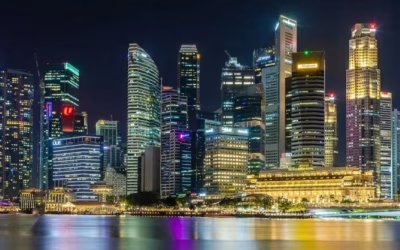
For Singapore to maintain our success and prosperity, we must stay open and carve a role for ourselves in global supply chains, including in new and emerging areas.
Today, trade remains at over three times our GDP.
Our network of 27 Free Trade Agreements enables our businesses to enter markets far larger than Singapore’s domestic market. I am glad that we had the foresight to pursue this policy.
For our SMEs, in particular, these FTAs help to unlock opportunities for them to be part of foreign companies』 supply chains, and in growth regions like ASEAN, Asia and even Latin America.
We continue to grow by establishing collaborations and complementarities with businesses around the world.
Management guru Peter Drucker once wrote that organisations make strengths productive and weaknesses irrelevant.
His basic point is each individual has strengths and weaknesses.
Through collaboration, executives could build complementary strengths for stronger organisations.
And the same can be said for businesses, economies and countries.
Given Singapore’s limitations in land and population size, we cannot realistically produce everything we need on our own.
By working with partners from around the world, our enterprises can tap on a broader bench of expertise, and tap on collective strengths, to unlock growth.
For the Singapore economy to stay competitive, we must stay open.
The work of SICC and other chambers – in building bridges between foreign and local enterprises and sustaining support for free trade and investment is very valuable.
That was how you started in the first place 188 years ago. And as we go forward into Industry 4.0, your focus on collaborative innovation will be most useful.
In the coming years, I believe science, technology and innovation will drive the future of economic growth. There are several reasons.
The first is demographics – the global workforce is shrinking – due both to ageing populations and declining birthrates.
The UN projects that by the mid-2030s, people aged 80 and above globally will outnumber infants.
By 2080, 55 years from now, the number of people aged 65 and above globally will outnumber those aged below 18.
In Singapore, around one in four Singaporeans is expected to be 65 years or older by 2030 –25% of our population. Just 15 years ago when I was still young in 2010, the figure was around 10%.